
What your bad habits are for
and how to craft replacements that actually stick

I came home from class on a Tuesday, excited. I had a few hours of engineering homework to get through, and after that I was going to dig into decision theory, which I had been looking forward to all week. The plan was clean. The plan was doomed.
The homework was painful. Somewhere in the middle of it, I opened YouTube “for a quick break.” One video became three. Three became a loop I wasn’t really watching so much as letting run. When I next looked up, it was 2am. The homework was half-done. The decision theory hadn’t been touched. I felt ashamed, then angry, then the particular kind of tired that comes from having neither worked nor rested.
I have done some version of this more times than I want to count. I have tried discipline. I have tried schedules. I have tried, earnestly, telling myself that I would not do this again. The pattern barely wavered.
What eventually changed things was noticing that my attempts were trying to subtract a behavior without understanding why it was there.
Behaviors are for something
Every behavior that persists is doing something. That is not a motivational slogan, it is the natural consequence of taking behavior seriously. In earlier essays I have argued that action is driven by problems: active pressures in a system, oriented toward some pole. The system is always trying to resolve its problems. If a behavior keeps happening, some system is getting something out of it.

This makes “just stop” the wrong response. “Just stop” leaves the problem active. The behavior was the resolution: take the resolution away, and the pressure is still there, still looking for release. The behavior wasn’t the disease, it was the symptom of a system with nowhere else to put itself.
You can see this in your own attempts at suppression. You white-knuckle it for a while, then the resolution returns, often worse. The bad habit is not weakness. It is a successful answer to a question you have not asked out loud.
Worth flagging: the system doing the answering is often not the conscious one. I wrote recently about map atrophy, the way the conscious model of your situation loses information under cognitive load. The problem driving a bad habit is frequently running in your territory without being clearly present in your map. That is part of why the habit feels inexplicable from the inside: the system that is solving it is not the one that is deliberating about it.
The first move, then, is to stop asking “how do I stop doing this?” and start asking “what is this doing for me?”
What the media was doing for me
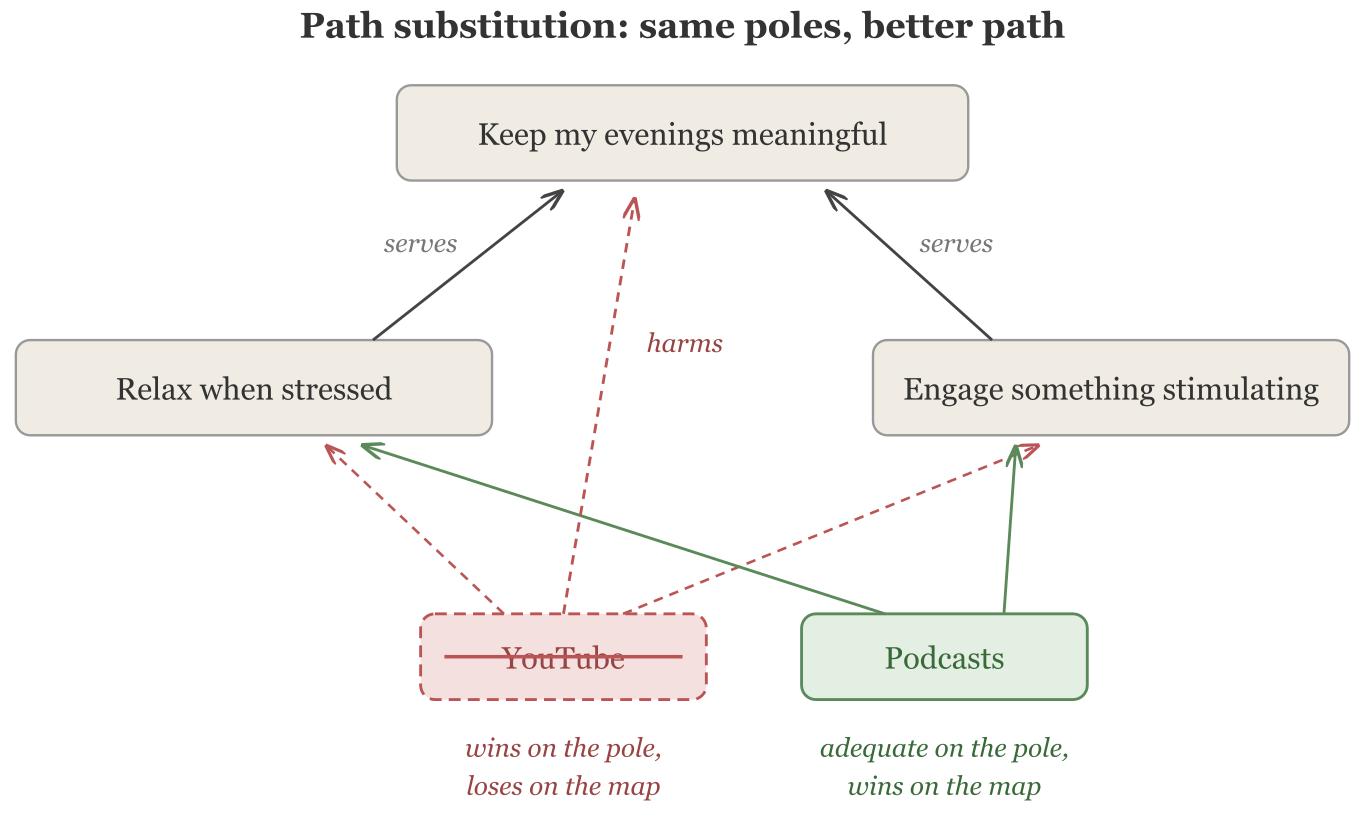
When I finally asked that question about the YouTube loop, the answer was not hard to reach, though it had been hidden in plain sight. Watching media was resolving two problems at once. When I was stressed, I wanted to relax. When I was stressed, I also wanted engagement: something in my head that was not the pain of the homework. Media did both, on demand, with no setup cost.
This matters because it reframes what a replacement has to do. If I want to stop watching, I cannot just remove the behavior. I have to find something that resolves those two problems, or the pressure will keep finding its way back to the screen.
And here is the first honest thing to say: media is probably the best possible answer to those two problems considered by themselves. It relaxes me more than most things. It engages me more than most things. On the immediate pole, it wins.
So why does it still feel wrong? Because the pole is not the whole story.
My media habit serves “relax when stressed” and “engage something stimulating.” Those are not ends in themselves. They are in service of larger aspirations: recover well enough to come back to the work I care about, keep my evenings from vanishing, protect time for things like decision theory. Looked at in isolation, media wins. Looked at in the context of those larger aspirations, it is a disaster.
This is the trick to finding good replacements. You are not looking for something that beats the bad habit on its immediate pole. You are looking for something that serves that pole well enough without trashing everything else you care about.
For me, that turned out to be podcasts. Podcasts relax me less than a video. They engage me less vividly. But they do both, adequately, and they are vastly easier to step away from. A podcast plays while I do dishes; a video pulls me in. The reason is the stimulation gap: video is so much more stimulating than nothing that the contrast between watching and not watching is sharp, and that sharpness is what makes breaking away hard. A podcast is mild enough that there is no such cliff. Stopping a podcast is a small step down. Stopping a video is a fall. Once I saw that, I could make the substitution: listen to podcasts instead of watching media. I added friction to the losing path (browser extensions capping my time) and reduced friction on the winning one (a short list of podcasts queued up for easy access).
This is the first move: swap the path while keeping the pole. Find something different that gets the job done, judged by your actual problem map and not by the pole alone.
When the pole itself is the problem
Sometimes the issue isn’t the path. It’s the pole.
Take the homework story from the start of this essay. The bad behavior was watching media. The pole it served was something like “recover from stress while doing homework.” The first move — better path, same pole — gave me podcasts. A real win.
But there is a deeper question available. Why is the parent problem (keep my evenings meaningful) being served by “recover from stress while doing homework” at all? That sub-problem only exists because the homework was stressing me out. What if the parent could be better served by a different sub-problem entirely: “do not become stressed by homework in the first place”?
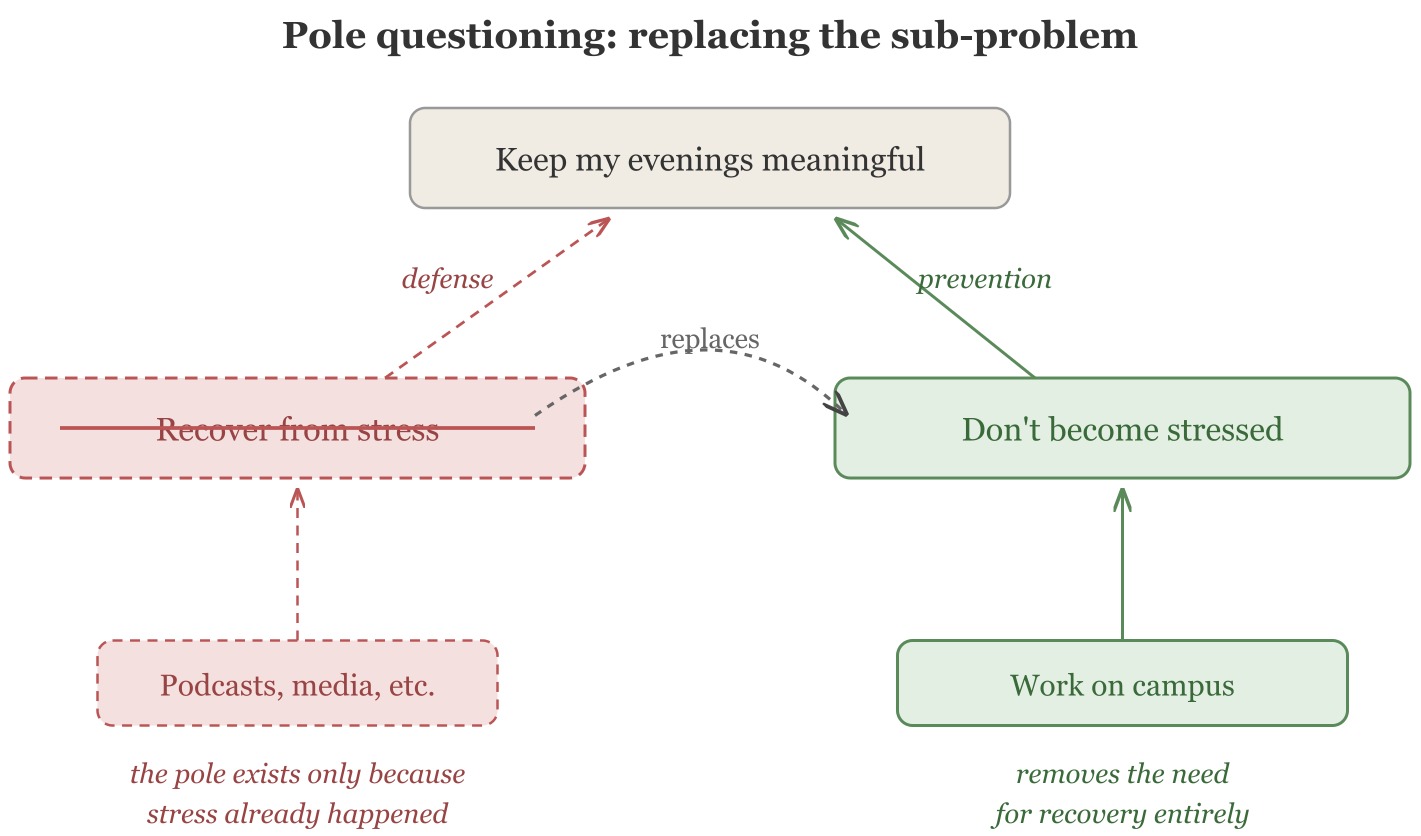
When I tried this, the answer was concrete. I am much less stressed doing homework on campus than at home. Something about the environment — being around other people working, being out of the room I sleep in — keeps the homework from grinding me down the way it does at home. So a different sub-problem joined the map: “be on campus most of the day, most days.” That serves the parent better than the recovery path ever could, because the recovery path was always playing defense.
This feels like a different move from path substitution. Not “find a better path to this pole,” but “question whether this pole belongs here at all.” But it turns out these are more alike than they seem.
The two moves are the same move
These look like two moves, and they feel like two moves when you are in the middle of them. They are not. They are the same move applied at different levels of your problem map.
Here is why. “Recover from stress” sits underneath “keep my evenings meaningful”: reaching the pole of the smaller problem (being recovered) is one of the things that moves the bigger problem toward its pole. So when I ask “is there a better path to recovery than YouTube?”, I am working inside the smaller problem. When I ask “is recovering from stress even the right way to keep my evenings meaningful?”, I am asking the same shape of question one level up: is there a better path to the bigger problem’s pole, given that the smaller problem is currently part of it?
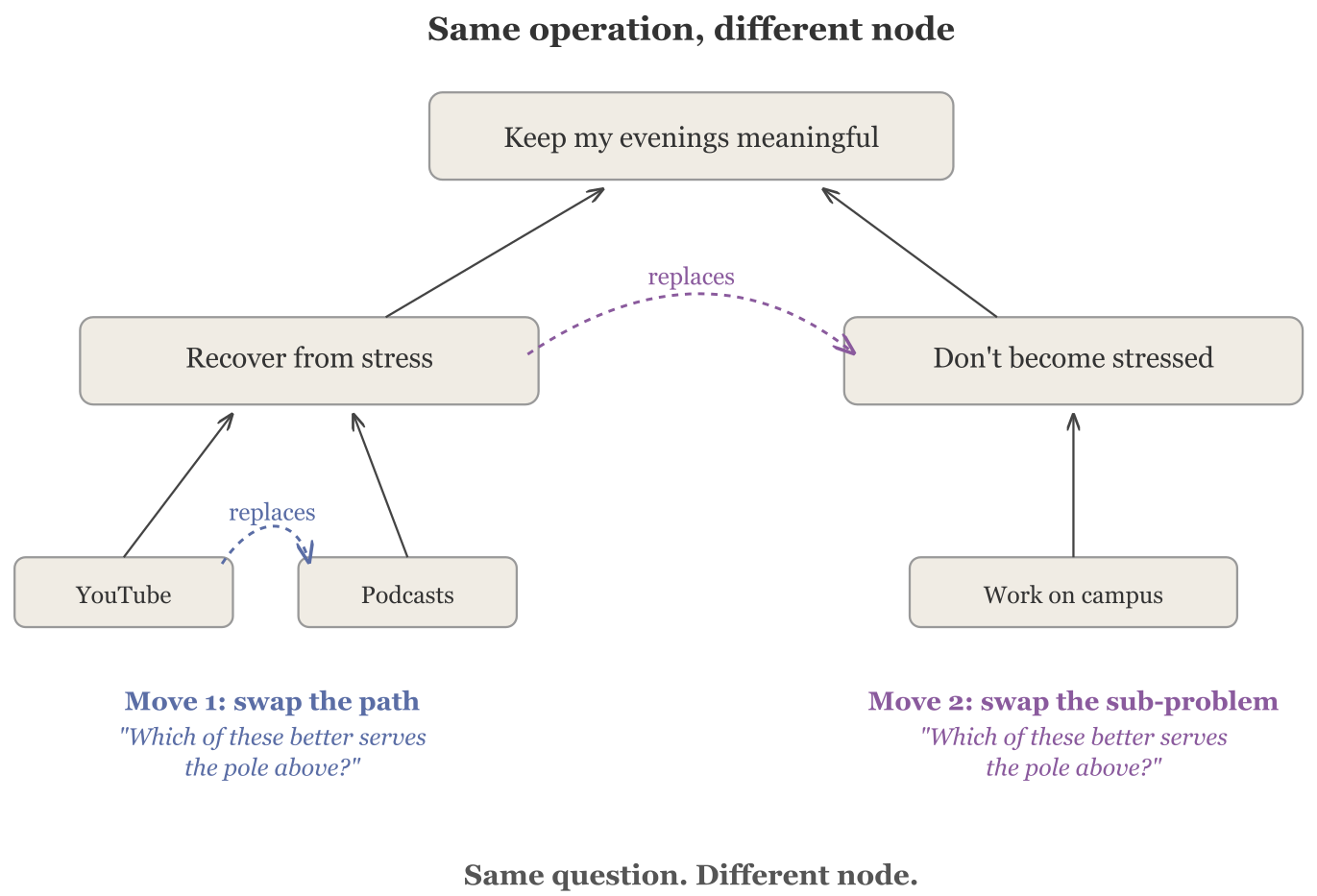
Path substitution and pole questioning are the same operation at different nodes. You can always shift which level you are working at. If you cannot find a better path to the pole in front of you, go up: maybe this pole is not pulling its weight for the problem above it. If the parent problem seems untouchable, come back down: maybe some of its sub-paths can still be improved.
The practical consequence is that your replacement does not have to serve the exact pole you started with. It has to serve whatever your actual problem map, taken as a whole, wants served. The map has slack. Use it.
Understanding is sometimes enough. Often it isn’t.
There is one more thing that determines whether a replacement will stick: whether it actually delivers.
Some bad behaviors are really failures of imagination. You order delivery every night because you never thought of microwaveable meals. The moment you see the alternative, the behavior changes. Understanding is the whole fix. These cases are real and more common than people give them credit for: a lot of what looks like a habit is just a path nobody has bothered to look for alternatives to.
But real habits and addictions are different. Understanding is necessary and not sufficient. I understood perfectly well that media was eating my evenings, for years, and kept doing it anyway. Seeing the problem did not deplete the problem.
What shifted things was that the new behavior had to actually resolve the underlying problem in a way I could feel. Not “this is theoretically better.” Not “this should work.” Delivering, in the moment, on the thing media was delivering on. If the podcast didn’t relax me at all, I would have bounced right back to the video. It had to be at least adequate, reliably, on the immediate pole. And the first few times it was, something like reinforcement happened: the new path became a real option in the system, not just a note in the map.
So when you design a replacement, design it for the in-the-moment test. The substitute has to show up when the pressure shows up. It has to work, more or less, the first time and the second time and the tenth time, or the old behavior will keep winning the comparison.
Practically, this means making the replacement actually available. If it requires setup, preparation, or thinking in the moment, the old behavior will beat it every time. I keep a short list of podcasts queued and do not decide in the moment. It also means adding a little friction to the old behavior: not enough to make yourself miserable, just enough to tilt the comparison. Browser extensions, the TV remote in another room, whatever is proportionate. And it means letting the replacement be imperfect. You are looking for good enough on the immediate pole, not best.
Closing
The behaviors you want to change are not enemies to defeat. They are solutions to problems, working as well as they can given what they have access to. Treat them as information. The fact that a behavior is stubborn is telling you something: there is a live problem behind it that your current options aren’t resolving any other way.
The move is to find that problem, look at where it sits in your map and what it serves, and then craft a replacement. Sometimes the replacement is a different path to the same pole. Sometimes it lives one level up: a different sub-problem entirely, in service of the parent. Either way, set it up to deliver in the moment, and give it enough repetitions that the system can learn the new answer.
The old behavior does not have to lose a fight. It just has to stop being the best available option.
Written with the help of AI.
I like it. Need to find an alternative to doom scrolling:) maybe a set of Wikipedia topics that I am interested in…or as you say, change my reaction to the underlying cause.