
What does the lemonade stand want?
Organizational problems

Alex and Sam set up their stand on the first Saturday of August. The spot is good: a corner near the park, foot traffic from the tennis courts. Alex has a folding table from his garage; Sam brought the lemonade and cups. They have not talked about what they each hope to get out of this.
The first customer shows up at noon and asks for two cups. They charge a dollar each. Easy. An hour later, demand picks up and Alex wants to raise the price. Sam pushes back: more customers means staying later, and Sam has plans at four. They keep the price at a dollar. At three-fifteen, Sam starts putting the remaining lemonade in a bag. Alex protests. They sell out by three-forty-five, make twelve dollars, and leave without speaking.
The following Saturday, the same stand, different decisions. They buy fewer lemons. They close earlier, citing low supply. They charge a dollar-fifty. To a stranger watching from the park bench, the stand seems to have no consistent strategy.
But the stand does have something it is oriented toward. The problem is that what it is oriented toward has never been named.

In the essays so far, problems have belonged to a person. You have an aspiration. You map it, go up to understand why it matters, go down to figure out what to do. The framework is personal because the most immediate use is personal.
But problems are not personal in their logic.
In an earlier essay I introduced the thermostat: a system with a target temperature of seventy degrees, oriented toward that state, acting to reach and maintain it. The thermostat has a problem (needing to get the room to the temperature), a pole (the room at seventy), and behavior that moves toward the pole. The thermostat is not a person, yet it has a problem.
Any system that behaves consistently toward some state of affairs is a system with problems.1 The behavior is the evidence. The state the system keeps moving toward is the pole. You do not need consciousness, or intentions, or a diary entry. You need only a pattern of behavior that tracks something.2
Alex and Sam’s lemonade stand is a system. It has states: how many lemons it has, how much money, how much lemonade, how much demand. It has behavior: pricing decisions, purchasing decisions, closing time. And it is oriented toward something, whether or not Alex and Sam have said so.
The question is what.
Where the introspection lives
If the stand were a person, you could ask it. Sit it down with a piece of paper and ask: what is this for? Why does it matter? Keep asking until you hit something that matters on its own. A good answer can come through reflection, however imprecise.
The lemonade stand is not a person, but the introspection has not vanished. It has just spread out.
You can ask Alex what he thinks the stand is for. You can ask Sam. Each will give you a partial answer, because each is a piece of the system with a working model of the whole. Neither answer is a direct readout of the stand’s orientation. But each is real evidence about it.
The reports get richer when you press past the decisions that have already happened and into the ones that have not. Ask each of them how the stand would respond to situations it has not yet faced. What would we do if we hit a hundred dollars by two? What would we do if it started raining at one? Hypotheticals surface commitments that day-to-day decisions have not had occasion to test. If both Alex and Sam say that, after a hundred-dollar Saturday, they would try to do this more often, that is evidence about a feature of the system even if no Saturday has yet hit a hundred dollars.
Then there is a second channel that does not run through anyone’s report at all: what the stand actually does. What price Alex and Sam settle on when they disagree. What time they actually close. Where one of them pushes back hard and the other yields. Reports tell you what each person thinks the stand is for; behavior tells you what the stand has been doing while those reports were being formed. When the two diverge, the divergence is itself information.
So introspection is available, but it has a different shape than with a single person. With yourself, you have one introspective channel plus your own behavior, and the two are housed in the same body. With an organization, you have several introspective channels, each one partial, plus the system’s behavior, and the work is to triangulate. No single member has the whole picture.3 The system’s orientation lives in the overlap and the gaps among the partial views, plus what the behavior actually does when those views disagree.
This is the practical difficulty with organizations. Not that you cannot ask, but that any one answer is partial, and the answers may not line up with each other or with what the system does. You have to read several things at once, and you have to be honest about which parts of the picture come from which source.
What going up looks like for two people
Take the price decision. Alex wants to raise the price of lemonade from one dollar to two. Should they?
The answer depends on what the stand is after. If its orientation is to maximize revenue before September, the question is whether doubling the price will hold demand or halve it. If demand holds steady, raising the price is exactly right: same lemons, twice the money, done earlier. If customers start going to the kid down the street, it is wrong.
But the stand is not clearly oriented toward maximizing revenue. Sam is also in the system, and Sam’s pole is different: finishing at a reasonable hour. Which means a raised price that keeps customers arriving all afternoon serves Alex’s orientation and actively damages Sam’s. The right decision depends on what the stand is after, and the stand does not know what it is after, because Alex and Sam have never surfaced it together.
Going up, for an organization, means doing the triangulation deliberately. Ask each person what they think the stand is for. Ask what they think it would do in cases that have not happened yet. Watch what it actually does. Then look for the orientation that explains all three.
The first time Alex and Sam tried, it took twenty minutes and some arguing. Alex kept saying “money” and Sam kept saying “time” and neither felt heard, because both were stating their individual poles rather than the system’s. What eventually came out was something neither of them had said before: they wanted the stand to be worth it. Worth the Saturday. Worth the setup and the sunburn and the time away from other things. That was the pole, and it had both money and time in it, in a ratio that neither of them had articulated before the conversation started.
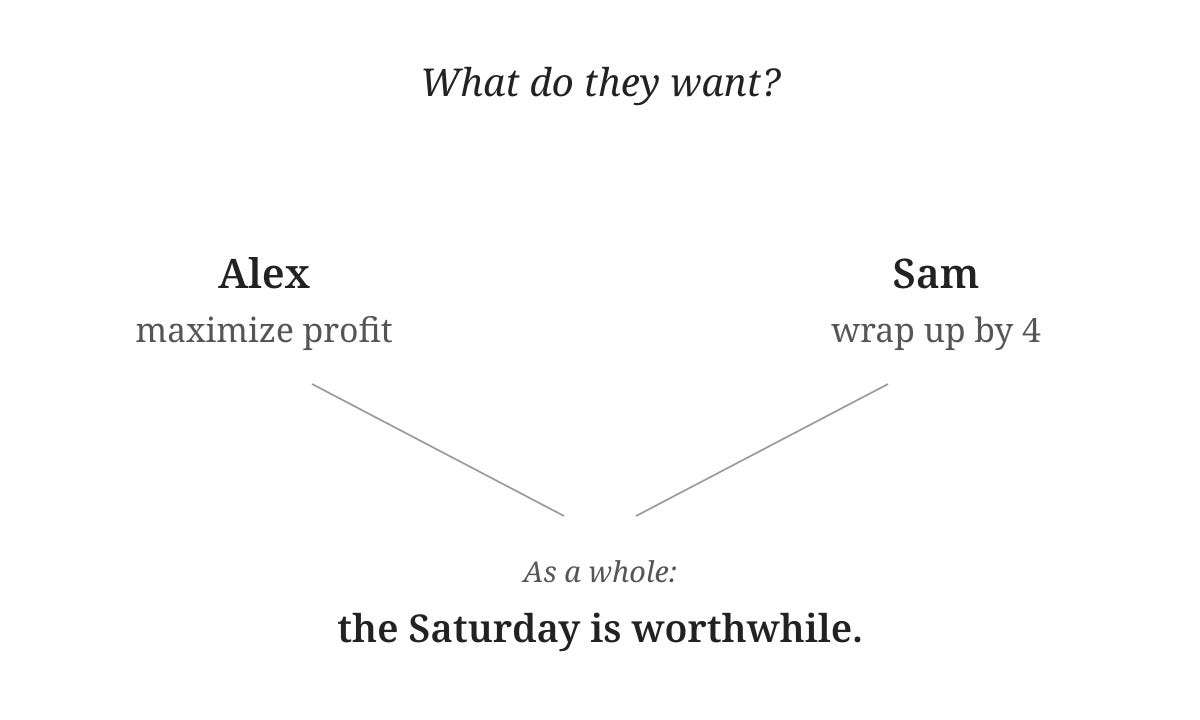
This is what joint aspiration looks like. Not a compromise between two individual poles, not Alex’s goal and Sam’s goal averaged, but something that only becomes visible when you hold all the partial views and the behavior at once and ask what would explain them together. It is often not what either person would have said if asked alone.
Once the aspiration was explicit, going down became tractable. Should they raise the price? Given that they want the stand to be worth it by two-thirty with something real in their pockets: raise the price a little, set a hard close time, stop before it stops being worth it. The inconsistency of the previous two Saturdays was what happens when a system has no explicit orientation and each decision gets made from whoever has the stronger opinion that moment.
Stated aspirations and revealed ones
Every organization has a version of this problem, and in larger organizations it goes further. The stated aspiration and the actual behavioral orientation diverge, sometimes by a little and sometimes by a lot.
A company says its orientation is serving customers. Its pricing structure, its cancellation policy, and where its engineering resources actually go suggest that the orientation is closer to retaining revenue. Neither version is a lie exactly. The stated aspiration shapes how employees talk, how they frame decisions, what they feel good about. But the behavioral orientation shapes what the company does when the two come into conflict, and that is more load-bearing.
This is where the multiple introspective channels stop being only an asset. If you ask employees what the company is for, many of them will give you the stated version. The stated version is what gets repeated in meetings, written on the careers page, and absorbed by every new hire. People can be sincere about it and still be reporting the wrong pole. The behavioral version is harder to elicit through any single channel, including any one inside report. It surfaces when you triangulate: what the company says about itself, what its people believe it is doing, and what it actually does when the three pull apart.
Going up for an organization means asking what the system is moving toward, not what it says it is moving toward. The behavioral version is harder to see precisely because so many of the inside reports converge on the stated one. It is what you would deduce if you held all the inside accounts in mind, watched for six months, and trusted the watching slightly more than the accounts.
This matters practically because decisions made from the stated aspiration and decisions made from the actual orientation can point in different directions. A team that says it cares about quality but is behaviorally oriented toward shipping fast will find its quality decisions overridden one by one, each time with a local justification, until the gap between stated and actual becomes too large to ignore.
Map atrophy at scale
Map atrophy happens to organizations too, and the mechanism is worse.
When a person is under pressure, the complex aspiration structure collapses into whatever is most immediate. The reasons something matters recede from conscious thinking, and behavior starts optimizing for the compressed version. I have written about how to fight this: externalize, review, query the territory deliberately.
When an organization is under pressure, the collapse happens across everyone simultaneously, and the simplifications are not even the same. One person’s compressed map drops the mission; another’s drops the financial constraint; a third’s drops the team’s well-being. The organization starts making decisions that feel incoherent from outside, because they are being made from three different atrophied maps by people who have stopped checking whether their working models still agree.
This is exactly what makes the distributed introspection harder under load. Each channel is still available, but each is reporting from a more compressed version than usual, and the compressions point in different directions. The triangulation that worked when everyone was rested produces noise when everyone is exhausted. The honest answer to “what is this team for” can come back four different ways, all sincere.
There is no cognitive load that fixes this automatically. Unlike a single person who can sit down with their problem map and ask what has been forgotten, an organization has to build that practice deliberately, into how it meets and how it makes decisions. Externalization helps: the reasons the organization exists, written somewhere accessible, brought back into the room when pressure builds. The same logic as writing your own aspirations down, for the same reasons. What is not written down will be dropped.
The Saturday morning where Alex and Sam finally talked was not a dramatic breakthrough. They sat on the curb before setting up, drank their own lemonade, and worked it out. The aspiration they found was not complicated. But it had not been said, and without it, all the decisions had been arguments about symptoms rather than about what the stand was actually for.
Any system
The tools built in these essays were framed personally because the most immediate use is personal. But they are not personal in their logic. A problem is a drive in a system oriented toward a pole. Going up asks why a state of affairs matters. Going down asks how it might be reached. Review keeps the map from drifting.
These questions have the same structure whether the system is you mapping your own aspirations, two people figuring out what their Saturday is for, or a department trying to understand why its meetings feel like performance rather than work. The difference is not in the questions. The difference is in where the introspection lives. With yourself, loosely one channel plus behavior, both close at hand. With an organization, several partial channels plus behavior, and the work is honest triangulation among them.
When you are trying to understand an organization from outside, or building one, or trying to figure out why a team keeps making the same kind of mistake, the same move applies. What is this system after? What does each person inside think it is after? What does its behavior reveal when those answers diverge? What would going up look like here, if you surfaced the orientation that only becomes visible when you hold all of them at once?
On their third Saturday, Alex and Sam had the best day the stand ever had. Not the most revenue. The best day. They made enough to matter, finished before the light changed, and packed up without arguing.
The aspiration was not Alex’s and not Sam’s. It was the system’s.
Written with the help of AI.
Really, any system that reacts to its environment has “problems”, or, more generically, teloi.
The actual telos is not determined by the observed pattern of behavior but by the true configuration of the system, which can be modeled from the pattern of behavior.
Individuals also do not have the whole picture, but they are closer to having introspection map on to the system proper.
I get the concept and will reuse some of the sentences written here. But to be honest, a bit long….almost like philosophers!